Showing posts with label West End. Show all posts

Wednesday, March 28, 2012

Review: She Stoops to Conquer


She Stoops to Conquer was first performed in 1773, and yet something about it remains relevant and appealing to a modern audience.

Considering the pompous costumes this show demands, National Theatre have managed to produce a remarkably fresh interpretation. At times it’s so fresh that you forget the script is unaltered from the original.

Tonight is special because the National Theatre are filming this performance and beaming it live around the world. Before the lights go down, two television screens on the side of the stage, show us a presenter delivering a live introduction from the roof of the building. Throughout the show, these screens continue to show us what is being broadcast. I found it quite entertaining to watch them briefly during the live performance and imagine others at the exact same moment experiencing this performance with only the screens.

When the show begins, I’m captivating immediately. A catchy pub-like tune has been composed and an enormous chorus appear on stage singing it in the style of an A Cappella group – though in this case they are backed by an impressive band.

It’s quite riveting and reminds me of a version of the Threepenny Opera I once saw that opened with Mack the Knife. That was an equally genius opening but sadly the same zest didn’t infuse the rest of that show, and I was underwhelmed.

Thankfully, that didn’t happen this time around, and I found myself enjoying every moment.

Sophie Thompson as Mrs Hardcastle.
The main thrust of the story involves a rich girl pretending to be a barmaid in order to be seen as interesting (and not stuffy) by a visitor who is staying in her father’s house under the false pretence that it’s an inn.

This show is consistently clever and witty. Particular mention must be given to Sophie Thompson, whose hysterical Mrs Hardcastle steals the show.

But really, the people behind the scenes at the National must be given most of the credit. The direction is superb, the inclusion of bizarre chorus songs to bring pace is genius, and the staging is among the best I have ever seen.

If you’re in London, go see this show. If you’re not, try to find a copy of the BBC broadcast – and you can watch it knowing that I saw the exact same performance!


Wednesday, March 21, 2012

Review: Mamma Mia

I’ve been avoiding this show ever since I moved to London. That’s how much I despised the movie. I was even offered free tickets at one point. I already had tickets to something better that night (unfortunately).

When I decided to finally go and see Mamma Mia, I tried to shake off all my preconceptions about this show and just enjoy it. I reminded myself that it’s the original jukebox musical, and it’s a little unfair to hate it just because it spurred a decade of underwhelming musical theatre that continues to stifle originality on both sides of the Atlantic.

I can’t deny that it’s good fun. Who doesn’t love ABBA? That’s the whole premise behind the jukebox musical. The tagline on the Mamma Mia tube posters at the moment is – I kid you not – “you already know you’re going to love it”. With an audience preconditioned to love you, you can’t really go wrong!

Some credit has to be given to Judy Craymer, who conceived the whole idea, for creating a storyline that fits in most of the songs. But no matter how enjoyable the songs may be, the fundamental flaw with jukebox musicals is the difference between a concert and musical theatre. A good concert is a series of good songs. But a musical needs more than this: each and every song must add to the story. You can still have group dance numbers and big ballads, but ultimately each and every song furthers the narrative in some way.

A good writer can achieve this with a couple of the songs in a jukebox musical, but overall the majority of them can achieve only that whimsical satisfaction you get when you hear a song you like at a concert, and not the level of emotional connection and storyline momentum that a musical needs to be anything more than  bubblegum. Mamma Mia is full of songs that were written to make you smile for three minutes, and only a handful actually do anything for the plot.


The singing and dancing is very, very good, but the producers take absolutely no risks (why can’t Donna be  alone on an empty stage for the end of The Winner Takes it All?). And at the end of the day what little interesting character development there has been, is mostly thrown away for a happy ending; Donna, a woman who has shown herself to be proudly single and genuinely happy, is still a shrew to be tamed by a man with a ring.

If you already know you’re going to love Mamma Mia, then you probably will. If you need something with a bit of originality, substance or flair in order to get your money’s worth from a night at the theatre, then pick something else.

Monday, March 19, 2012

Legally Blonde Again


Legally Blonde is one of those shows that sounds average, but leaves you surprised as you leave the theatre at how much you've enjoy it. I saw it last year and loved it. So, when I heard that it was closing at Easter, I made sure I booked again while there was still a chance, bringing a bunch of friends along for the ride.

I have little to add to what I said last time. Most of the cast was unchanged, apart from Elle, who was equally fantastic to the girl I saw last year.

I’ll miss knowing that this show is on every night in my city. Although I’m mildly ashamed to admit that I can’t wait for the amateur rights to be released...

Monday, March 12, 2012

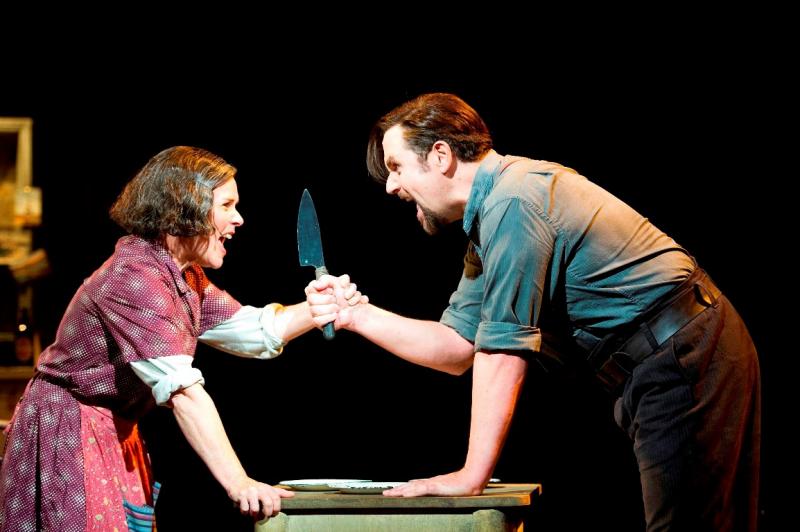
Review: Sweeney Todd


Sweeney Todd is probably the most macabre successful musical in history. The gruesome plot revolves around a barber slicing the throats of his customers, who are promptly chopped up and stuffed into pies by his bakery owning accomplice.

I would speculate that it laid the foundation for other grime-fest (Les Mis) and sinister (Phantom) blockbuster musicals that followed over the next decade.

Sondheim’s score is, as always, genius. Demonstrating that he’s one of the few Americans who understands the British stiff upper lip, there are no big belt songs – just a series of gently simmering, discordant refrains that are established in the first act and crescendo into a riveting, perfect nightmare during the second.

An almost unrecognisable Michael Ball brings a much-needed likeability to the murderous protagonist, drawing a fresh ‘whimsical next-door-neighbour’ side from Sweeney. Originality is difficult to achieve with a role we’ve seen performed so well so many times before, and he must be credited for it.

Given she found fame as a film actress, I was initially sceptical about Imelda Staunton’s casting in the demanding role of Mrs Lovett. But I was completely wrong. Her comic timing was impeccable and her voice was excellent. She faltered once with a clumsy switch to head voice, but that’s the only unfavourable comment I can make about her performance. My favourite moments in the show all belonged to her – The Worst Pies in London was hysterically funny without being slapstick, and her Nothing’s Gonna Harm You brought out exactly the right degree of menacing undertones to make it the creepiest lullaby ever written.

The chorus is extraordinary – this is one of the few shows that doesn’t require them to dance, or look like supermodels. The result of this is that they have all been cast based on their vocal talent alone – and this shows in their ability to tackle even the most elaborate of Sondheim’s melodies without the slightest sign of strain.

In this tale, story is king. To date, no attempt to introduce avant-garde design, staging or effects (no matter how well-intentioned, such as the chorus doubling as the orchestra in the most recent Broadway revival), has quite pulled it off. Ultimately, any such endeavour is doomed to undermine the story by robbing attention. The artistic team behind this production must be applauded for understanding this, and opting for relatively simple, traditional set design, staging and lighting. No wonder Sondheim himself loved it so much.

The opportunity to experience a show of this strength with actors of this calibre doesn’t come along every day. If you are in London, do not let this one slip by.

Wednesday, March 7, 2012

Review: Singin' in the Rain


I often wish I loved old movies, but unfortunately I find most of them so trite that I have trouble paying attention. However, there are two classic films I can watch again and again: Some Like it Hot, and Singin’ in the Rain. Both have genuinely appealing storylines, are hysterically funny, and feature a trio of talented, deservedly famous actors.

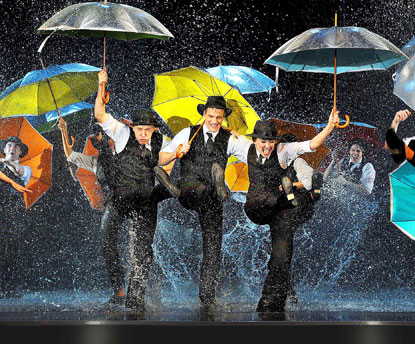
The Palace Theatre is now host to a brand new production with not only a perfect cast but onstage rain too!

With The Artist coming out on top at the recent Academy Awards, 2012 is the year the silent film came back. So it’s a fitting time to revive this beloved classic based in the period of transition from silent films to ‘talkies’.

Singin’ in the Rain was first seen onstage in the 80s, but the volume of the falling rain and the ensuing mic trouble resulted in a disappointing reception. Thanks to the wonders of modern technology, the new West End production has overcome these obstacles.

The set is mainly a sound stage at ‘Monumental Pictures’. Everything is black and white, and the edges of set piece facades are visible, which reminds us that everything is paper thin in the movie business.

There is not a bad note in the entire cast. Considering that every one of them must be a triple threat, this is astounding. Daniel Crossley’s Cosmo wins early fans as he shows his cheeky side in ‘Fit as a Fiddle’, but it’s Scarlett Strallen as Kathy Selden who really owns the show.

Few people know that Debbie Reynolds’ singing voice for all the more difficult numbers in the original movie was actually subbed in by an uncredited Betty Noyes. Yet Reynolds, who was not a trained dancer, still famously said that “Singin’ in the Rain and childbirth were the two hardest things I ever had to do in my life”. So, the fact that Scarlett Strallen can pull it off live every single night is astonishing.

While the title song is a clear highlight, every single number in this show is brilliantly written and interpreted for the stage - particularly Moses Supposes, Make 'em Laugh, and Good Morning. In fact, the only negative point I can make about the entire show is that Cosmo doesn't do 'the wall flip thing'. This really is a fantastic evening at the theatre that manages to do the treasured film proud.

If you’re lucky enough to sit in the second row, like I did, you will leave the theatre saturated.

Saturated, but grinning. And humming that irresistible tune.

Monday, February 27, 2012

Review: Master Class


Famed opera diva Maria Callas was a troubled soul, known earlier in her career for a large range and perfect pitch, and later on for a deteriorating voice and narcissistic ramblings.

Between 1971 and 1972, Callas gave a series of master classes at the Juilliard School in New York. These form the basis of Terrence McNally’s Tony award winning play.

We are the audience at Juilliard, watching this once great diva rip students to shreds and harp on about how her talent is unparalleled. The thing with this particular egomaniac is that she has the talent to back it up. Tyne Daly brings her to life beautifully, demonstrating an acting range as wide as Callas' voice; from Opera diva to passionate Greek to miserable, childless wife.

We see her perfectionism come through in the way she lectures the students, as though none of them could possibly have worked so hard or sacrificed as much as she did. Although the script is occasionally overwritten, it does paint its picture beautifully, and the several scenes where Callas' slips back into her memory are delicious to watch if you're prepared to overlook the cheese factor.

Overall, it's a solid performance that provides a worthwhile behind the scenes look into the life of the greatest Diva in modern history. Highly recommended.

Wednesday, February 15, 2012

Review: The 39 Steps


Director Maria Aitken's interpretation of Alfred Hitchcock's classic spy farce is the most self-aware show I have ever seen.

And I mean that in the best possible way. The show has two layers of humour: one from Hitchcock's "dashingly good" show itself, the other from cheeky actors making light of absurd theatrical conventions. It's only natural to poke fun, considering four actors play 136 roles in 90 minutes.

I knew I was going to enjoy it from the moment two menacing Russian gangsters ran on stage right carrying a lamppost and quickly froze against it looking stern, just as the hero glances out his window. When he looks away, they run off as conspiciously as they arrived.

Another gem includes two actors playing both motel owners and policemen at the same time, each switching back and forth continually to further the conversation.

Throughout the play, the audience feels as though they're in on a secret. It's the theatrical equivalent of winking at the camera.

Under the wrong director, this would be played for laughs (a la Shrek), but Aitken's staging is classy enough to deliver this layer of theatre in-jokes without distracting from the heart of the original story.

By jove it's a thoroughly enjoyable night, and I shan't spoil it for you by giving away any more of the plot, I'll just say that it's jolly good fun.

Sunday, January 29, 2012

Review: Children of Eden


Stephen Schwartz’s lost musical.

All theatre geeks (especially those fond of that other show he wrote; Wicked) have heard of Children of Eden, but few have seen it. After all, a musical about the first few chapters of Genesis doesn’t sound immediately gripping.

This is a special one-night-only charity gala performance, and it’s brought together a killer cast of West End stars. The Prince of Wales Theatre is usually the home of Mamma Mia,  so the staging for this performance is pared back – a few large blocks on the stage and assorted lightbulbs dangling. This simple approach works a treat and allows the actors to really own the stage.

Opening the show are Oliver Thornton (Adam/Felicia in Priscilla) and Louise Dearman (Glinda in Wicked) as Adam and Eve. Thornton’s performance is good, but a little self-conscious. His voice, though excellent, is slightly too thin for the role. Dearman, on the other hand, proves herself capable far beyond the (already vocally demanding) role of cutesy Glinda. She effortlessly navigates through complicated Schwartzian melodies, bringing a caramel smooth Streisand sound to the role without losing that essential feeling of Eve’s humanity. She’s flawless, and by far the standout of the night.

The other conspicuously brilliant performance comes from Gareth Gates as Cain. I was sceptical when I read about his casting. Coming runner-up to Will Young in the first series of Pop Idol doesn’t exactly qualify someone to perform with the cream of London theatre. But I was wrong. Gareth is a theatre singer first, pop singer second. He approaches the role in Ramin Karimloo style: nimble, powerful, graceful, and impressive.

Gareth Gates as Cain.
I’m grateful when he kills his brother, because a woman I can only assume is Abel’s mum is sitting next to me and won’t stop snapping pictures of his every move on her very bright mobile phone. She leaves at half time, which I’m also grateful for because she isn’t exactly built like a ballerina and has been spilling over onto my seat for most of the first act.

Act II is less remarkable than Act I. There are some decent melodies and performers, but none so promising as Eve or Cain and their first act ballads. Still, the chorus sound wonderful together – voices fusing far more smoothly than you usually see when a group of soloists perform choral work.

The best moments in the second act come from Laura Samuels as servant girl Yonah, and Brenda Edwards (Killer Queen, We Will Rock You) as Mama Noah. Though she stole the second act with her gospel number, Edwards looked bored whenever she wasn’t singing. A shame.

After the performance, the director invites the writer of the show to the stage. I just about wet myself.

Unfortunately, it’s not Stephen Schwartz. It’s whatshisname who wrote the unremarkable book. But this disappointment is quickly forgotten when the reigning queen of London theatre, Kerry Ellis, takes the stage to finish the evening with an original song that’s been written for her; the somewhat unoriginally titled “Heal the World”. Her voice, of course, brings down the house.

Overall, a fantastic performance by true theatre stars who deserve every accolade they have heaped upon them.

Kerry Ellis.

Wednesday, January 25, 2012

Review: Matilda


From the moment you enter the Cambridge Theatre, you are entranced by the magic of Matilda. Rather than sport a traditional curtain, the entire proscenium is speckled with thousands of coloured books. In fact, most of the set pieces are constructed like intricate bookshelves.

The entire way through Matilda the Musical, I was thanking the universe that there are still some creative teams out there who are willing to bring children's theatre to life in a lateral way, rather than handing everything to the audience on a platter (Shrek, anyone?).


No musical can be respected without great music. And the real creative genius behind Matilda is Tim Minchin, who proves his syllable-squeezing musical comedy act is just as engaging without the potty humour he became famous for at the Edinburgh Fringe Festival.

Almost every song in Matilda the Musical is genius. Fitting for a story about a child prodigy. Minchin deftly handles Dahl's rough-edged style - like the musical equivalent of Quentin Blake's illustrations. He understands the way kids' minds work. He understands what makes Matilda special; both the character and the story.

Bertie Carvel's Miss Trunchbull is inspired. Rather than slip into to flamboyant pantomime drag, he simply inhabits the 50 year old headmistress in all her former-Olympian glory.

This is the best new show to come out of London since Billy Elliot. Actually, since before Billy Elliot.
The only slight disappointments are that Miss Honey's character isn't given any juicy songs, and that the big finale in the Trunchbull's house is traded off for a more Russian showdown.

That doesn't stop Matilda being the show to beat for this year's Olivier award. And, dare I say it, next year's Tony.

Wednesday, January 18, 2012

Review: Shrek


Shrek seems a more logical fit for the stage than other movie adaptations like The Lion King, Ghost or Legally Blonde.

Perhaps that's why the writers were so lazy? They were too comfortable? When a hermit character like Shrek starts to sing about his feelings, you know there's something wrong. When every single song is about his feelings... there's something very wrong!

It's like the old saying; "don't tell me you're funny, make me laugh!"

Unfortunately, this show didn't make many people laugh. The actors mostly had poor comic timing (particularly Donkey), and the only jokes that landed were half-baked regurgitations of one-liners from the movie.

Why, when the original movie is so genuinely humorous, would they add only fart jokes, while finding room for loads of faux-sentimental moments?

Unfortunately, this is the worst kind of lowest common denominator entertainment. I wouldn't recommend it to anyone. Sure, kids might enjoy it. But only because they don't know any better...

Wednesday, December 28, 2011

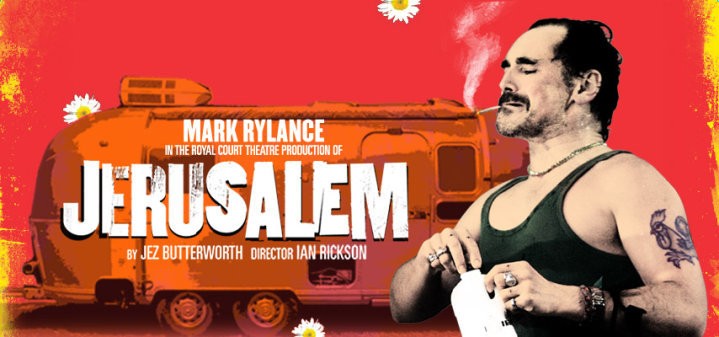
Review: Jerusalem


When Mark Rylance won the Tony Award for Best Actor earlier this year, I was kicking myself for not seeing him in Jerusalem on Broadway when I had the chance. Luckily, the show transferred back to the West End in October for a limited run.

We queued for ages to buy tickets before the show even opened. "what are the best seats you've got across the whole season" I asked. Turns out, the best they could do was the back row of the stalls the week between Christmas and New Year.

I knew this would mean seeing a three and a half hour play on our only night in London between trips... but quickly decided it was worth the sacrifice!

The show is difficult to describe. An unemployed bludger with a penchant for telling tall stories is squatting in a trailer on council land and has caused no end of havoc for residents in over a decade. He's banned from every pub in the town. The council are trying one last time to evict him.

Mark Rylance's hilarious drunken dramatic monologues about everything from his rare blood type to meeting a giant near Stonehenge are the glue that holds the play together. His deadbeat friends are played excellently by a relatively large troupe for a one-set show. The most memorable is Ginger, an aspiring DJ, played by Mackenzie Crook of the Pirates of the Carribean trilogy.

I don't want to spoil the show by saying anything further, except that it wasn't much like I expected at all, and that I can now understand the hype.

Wednesday, December 7, 2011

Review: War Horse

War Horse won the 2010 Olivier in London and the 2011 Tony in New York for Best Play. It's been selling out so far in advance that we booked our tickets in early September! You can't get a seat now until March.


Most years the Tony goes to the play with the best acting. This year it was undoubtedly a win more for those off-stage than on - a decision I support 100%.

The thing that makes War Horse so special is Joey. A life-size, breathing, emotive, rideable puppet horse. It takes three puppeteers to give Joey life. His creators said that what they love about working with puppets is that an actor struggles to die onstage, whereas a puppet struggles to live. I love that.


The narrative of War Horse is based on a children's story. It's easy to boil it down to Boy Meets Horse, Horse is Drafted to First World War, Boy Follows Horse... but somehow it holds something special. Something unlike other simple-story shows. This show has a genuine heart.

The fact that Warhorse is able to make an audience invest so much into the relationship between a boy and what-should-be-an inanimate object is what makes it sublime.

I would recommend this show for the inventive stage design and puppetry alone.

Tuesday, December 6, 2011

Review: Noises Off

Michael Frayn's classic English farce is, in my opinion, the funniest play ever written.


The action centres around six overbearing actors who can't get on, their frazzled director, and two overwhelmed stage crew.

The genius is in the way the play repeats itself. You see the first act of their play-within-the-play not once, but three times. This allows a buildup of more hilarious gags than you can poke a stick at, because the audience are familiar enough with the material by the second and third times through that they feel like they're in in on the joke every time an actor messes up their lines or forgets a plate of sardines.

My favourite act is the second, when you watch the whole thing from backstage. The set is literally turned around, and you watch the same act you've just seen from behind, complete with backstage dramas, a cactus and a wayward axe. This requires immense talent (and stamina) from the actors, who must deliver all their lines both 'on' and off stage, most staying in view of the audience for the entire act.


The only actor I was familiar with going in, was Robert Glenister of Hustle and Spooks, who plays the director. His performance was the spitting image of Michael Caine's in the movie, which is certainly not a bad thing!

I soon recognised Celia Imrie from Calendar Girls, among other things. She had large shoes to fill - Carol Burnett's portrayal of Mrs Clackett in the movie is almost unbeatable. In the first act I was disappointed to see her throwing lines away, but she soon displayed her excellent comic timing - at it's best when she appears from her dressing room in dramatic, wounded silence in Act II.

The standout in my opinion was Janie Dee's portrayal of Belinda. She came across as more severe and career driven than I've seen in that character before, elements which added to her character immensely. I was somehow not surprised to discover after the show that she's quite an accomplished actress - in fact, the only actress to win all the major London acting awards in one year besides Judi Dench!

One thing I found odd was the English accents. My previous encounters with this show (about a dozen times on DVD and once performed very poorly by an Auckland regional theatre) have always featured 'American' actors performing a British play. This serves to separate the 'actor' from the role, and adds to gags when accents begin to slip as the show-within-the-show falls apart. The British accents in this version weren't down to an interpretation of the story, as it's originally an English play, but I personally really enjoy watching actors switch from one accent to another on stage, so felt that it missed a dimension. Though it added something wonderful to senile Selsdon's character, who plays the role as though treading the board with the RSC.

Overall, it's a magnificent staging of a wonderful show - one not to be missed!

(and I didn't even see a real performance - it's still in previews!)

Wednesday, November 2, 2011

Wicked the Sixth

Yep, I saw Wicked again!

I know I've seen (and blogged about!) it twice already this year, so I won't bore you with the details... except to say that Rachel Tucker is a fantastic Elphaba and I unfortunately can't say as much for the understudy Glinda.


Saturday, October 22, 2011

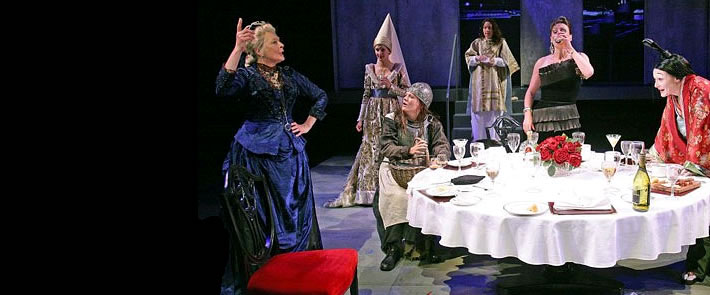
Review: Top Girls


In a word: fractured.

Top Girls staves off boredom by offering the most disconnected first act I have ever seen.

Caryl Churchill's entire first act is a dinner party of interesting (though crudely caricatured) women from history. The obvious gimmick being that they could never actually have met.


I needn't have worried about how the story would progress: it didn't. The curtain opens on Act II to an unrelated story about the Top Girls Employment Agency. The six actresses explore gender politics of the 1980s in a series of engaging, believable vignettes.

The story wraps up satisfactorily, yet I find myself unable to really recommend the show because of the indulgent, bizarre first act.

The play has grown on me in hindsight. The whimsical introduction does serve create a mindframe that affects how viewers will respond to the more 'real world' scenarios explored later on, which was probably the writer's intention. I just think it would have been better without.

Wednesday, October 5, 2011

Review: Jersey Boys


The story of the Four Seasons is a great watch, with a top notch cast. Jersey Boys was one of the first jukebox musicals, and it's a special one because, unlike Mamma Mia or We Will Rock You, the story being told is actually the story of the band themselves.

We were sitting in the front row, and the stage was four feet high. Our necks were sore as anything by half time, but the show was well worth it - we could see the beads of sweat on their foreheads.

I definitely recommend this show, and not just if you're of the generation that heard the music the first time round. You'll be surprised how much of it is familiar.

Wednesday, August 17, 2011

Review: Betrayal

There's nothing better than a sturdy relationship drama. Add a a sizzling performance from the effortlessly talented Kristin Scott Thomas, and you've got a winner.


The theatre was packed full. We had awful seats despite booking weeks earlier. At least a dozen poor folk were squinting from the standing-room-only area, clearly having lucked out on getting seats.

Harold Pinter's story is set over nine years, following three main characters over a seven year affair and the two years afterwards. What makes it special is that it's written mostly in reverse.

Scott Thomas plays Emma, the central character. She's married to one of the characters, but the play's core relationship is the one she shares with her husband's best friend.

Over the course of an hour and a half you watch all three of them evolve backwards from jaded individuals to enthusiastic lovers. It must be draining to perform, but it's absolutely mesmerising to watch.

Highly recommended.

Thursday, August 4, 2011

Review: Blood Brothers


I really want to be able to say that I loved Blood Brothers. The show is full of heart, and you do care for the characters.

But, I just can't. Like Les Mis (actually, even more) this show feels every bit of it's 21 years. If I couldn't see the orchestra I never would have believed that the music was live. It was all synth pads and MIDI piano.

For the most part I enjoyed the acting, but the guy playing Mickey looked about 45 and Mrs Johnston was pitchy on the high notes (she lost my vote when she chickened out of her only big note in the whole show - right at the emotional peak of her character arc).

Afterwards I found myself thinking that Blood Brothers would have been more enjoyable if they'd closed the original production after five years, then opened a modernized revival that addressed the musical flaws, toned down the many overstatements, and updated the staging.

I didn't hate the show. I was just disappointed because it didn't come close to it's potential.

At least dinner was delicious, and it was great to catch up with our friend Simon who's in town for a week.

Wednesday, July 27, 2011

Review: The Woman in Black

Not many shows try to scare the audience. And not many shows last 22 years on the West End. So when one does both, you know it's worth seeing. Also, Daniel Radcliffe is playing the lead in the movie adaptation.


I have to admit that I found the first act a little pedestrian. It was slow, and more than obvious that the play had been adapted from a book. I found myself wishing I had just read it instead. Perhaps, I thought, more modern shows (like Ghost Stories), despite owing a lot to The Woman in Black, are more able to deliver the promised chills.

But, I needn't have judged so soon - there's a reason this show stays open year after year. Act II does deliver, and even I had to muffle a scream at one point!

I doubt that this show is anybody's favourite. But I can see why it's lasted so long, and I would definitely recommend it to anyone who wants to see a quintessential London play. Well, after The Mousetrap anyway.

Tuesday, July 19, 2011

Review: Journey's End


I'm still a bit numb after Journey's End.

Because it was written so soon after WWI, in 1929, the play has a feeling of authenticity that gives it depth beyond other war stories I've encountered. This timing also gives it an interesting lack of perspective for the tumultuous period in history that was to follow. The result is a very raw play, with a view of war more like Jarhead than Saving Private Ryan: lots of sitting around and waiting for something to happen, then ten minutes of action. But don't get me wrong, this play is far from boring. It's too well written for that.

Early on, you learn that the company will be manning the trenches on the front line for the next week, a stake in time that gives the whole play a foreboding sense of countdown.

The acting is impeccable. Particular credit has to be given to James Norton's portrayal of Captain Stanhope, a character who has been on the front line since the start of the war. Despite being younger than me, he's worked his way up to the level of Captain, and along the way developed a coping mechanism based on alcohol and aggression. He fills the sizeable shoes of Sir Laurence Olivier, who originated the role. Also very noteworthy is 'fresh meat' 2nd Lieutenant Raleigh, who joins the company at the beginning of the play, and is brought to life with wide-eyed innocence by Graham Butler.

The final five minutes, including the bows, manages to be powerful without succumbing to melodrama. It's some of the most moving theatre I've ever seen. Paul and I didn't speak until we were almost at the tube.