Sunday, January 29, 2012

Review: Children of Eden


Stephen Schwartz’s lost musical.

All theatre geeks (especially those fond of that other show he wrote; Wicked) have heard of Children of Eden, but few have seen it. After all, a musical about the first few chapters of Genesis doesn’t sound immediately gripping.

This is a special one-night-only charity gala performance, and it’s brought together a killer cast of West End stars. The Prince of Wales Theatre is usually the home of Mamma Mia,  so the staging for this performance is pared back – a few large blocks on the stage and assorted lightbulbs dangling. This simple approach works a treat and allows the actors to really own the stage.

Opening the show are Oliver Thornton (Adam/Felicia in Priscilla) and Louise Dearman (Glinda in Wicked) as Adam and Eve. Thornton’s performance is good, but a little self-conscious. His voice, though excellent, is slightly too thin for the role. Dearman, on the other hand, proves herself capable far beyond the (already vocally demanding) role of cutesy Glinda. She effortlessly navigates through complicated Schwartzian melodies, bringing a caramel smooth Streisand sound to the role without losing that essential feeling of Eve’s humanity. She’s flawless, and by far the standout of the night.

The other conspicuously brilliant performance comes from Gareth Gates as Cain. I was sceptical when I read about his casting. Coming runner-up to Will Young in the first series of Pop Idol doesn’t exactly qualify someone to perform with the cream of London theatre. But I was wrong. Gareth is a theatre singer first, pop singer second. He approaches the role in Ramin Karimloo style: nimble, powerful, graceful, and impressive.

Gareth Gates as Cain.
I’m grateful when he kills his brother, because a woman I can only assume is Abel’s mum is sitting next to me and won’t stop snapping pictures of his every move on her very bright mobile phone. She leaves at half time, which I’m also grateful for because she isn’t exactly built like a ballerina and has been spilling over onto my seat for most of the first act.

Act II is less remarkable than Act I. There are some decent melodies and performers, but none so promising as Eve or Cain and their first act ballads. Still, the chorus sound wonderful together – voices fusing far more smoothly than you usually see when a group of soloists perform choral work.

The best moments in the second act come from Laura Samuels as servant girl Yonah, and Brenda Edwards (Killer Queen, We Will Rock You) as Mama Noah. Though she stole the second act with her gospel number, Edwards looked bored whenever she wasn’t singing. A shame.

After the performance, the director invites the writer of the show to the stage. I just about wet myself.

Unfortunately, it’s not Stephen Schwartz. It’s whatshisname who wrote the unremarkable book. But this disappointment is quickly forgotten when the reigning queen of London theatre, Kerry Ellis, takes the stage to finish the evening with an original song that’s been written for her; the somewhat unoriginally titled “Heal the World”. Her voice, of course, brings down the house.

Overall, a fantastic performance by true theatre stars who deserve every accolade they have heaped upon them.

Kerry Ellis.

Saturday, January 28, 2012

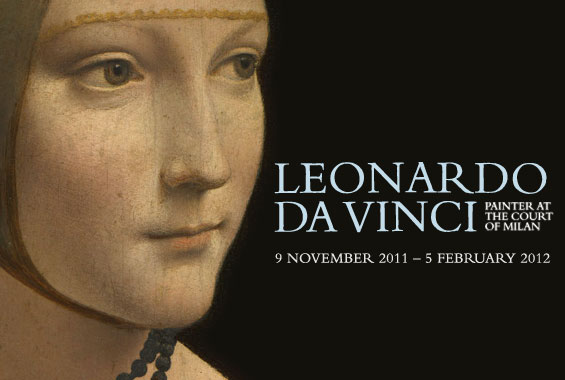
Leo in London: Part I

They’re calling it the greatest exhibition in history. More Leonardo da Vinci works in one place than ever before - including during his lifetime.

Of course, it sells out in record time. The National Gallery opens extended hours for three months and still sells all the advance tickets in less than a week. We miss out.

But there’s a glimmer of hope aside from the scalpers on eBay.

800 tickets per day are still available. In America they’d have a lottery. They believe everyone should have a chance. In England, they believe whoever puts in the most effort should end up on top. So they sell these tickets on a first come, first served basis.

Which is why Paul arrives at 7am, three hours before the ticket office even opens.

By 7:30, he’s been informed that he’s in the ‘maybe’ zone. He prays that the several hundred people who arrived even earlier are all nuns and widowers who won’t use their plus one, leaving his own entry within reach.

He sets about making friends with those around him. There’s a couple from Manchester who caught the train down just for this exhibition. None expected that 7am would put them so far behind the crowd.

The line starts to leak as people give up in favour of a hot coffee or a toilet break. Paul and his posse soldier on, blinded to their inevitable failure by an attempt to show solidarity.

The gates close around 1:30pm. The tickets have sold out about 20 people ahead of Paul. The group have waited for six and a half hours together and can’t bear to leave so soon. So they keep waiting (for some unknown reason).

A guy approaches Paul.

“My friend can’t come anymore. My ticket is for right now. I know you’ve been waiting for ages, so I don’t want to make any money off you. Just give me face value and it’s yours”.

Paul has no cash.

He comes home.

Wednesday, January 25, 2012

Review: Matilda


From the moment you enter the Cambridge Theatre, you are entranced by the magic of Matilda. Rather than sport a traditional curtain, the entire proscenium is speckled with thousands of coloured books. In fact, most of the set pieces are constructed like intricate bookshelves.

The entire way through Matilda the Musical, I was thanking the universe that there are still some creative teams out there who are willing to bring children's theatre to life in a lateral way, rather than handing everything to the audience on a platter (Shrek, anyone?).


No musical can be respected without great music. And the real creative genius behind Matilda is Tim Minchin, who proves his syllable-squeezing musical comedy act is just as engaging without the potty humour he became famous for at the Edinburgh Fringe Festival.

Almost every song in Matilda the Musical is genius. Fitting for a story about a child prodigy. Minchin deftly handles Dahl's rough-edged style - like the musical equivalent of Quentin Blake's illustrations. He understands the way kids' minds work. He understands what makes Matilda special; both the character and the story.

Bertie Carvel's Miss Trunchbull is inspired. Rather than slip into to flamboyant pantomime drag, he simply inhabits the 50 year old headmistress in all her former-Olympian glory.

This is the best new show to come out of London since Billy Elliot. Actually, since before Billy Elliot.
The only slight disappointments are that Miss Honey's character isn't given any juicy songs, and that the big finale in the Trunchbull's house is traded off for a more Russian showdown.

That doesn't stop Matilda being the show to beat for this year's Olivier award. And, dare I say it, next year's Tony.